
Sources Behind Atascadero Previous Residents
Atascadero house history works best as a layered record trail. The county recorder can establish a recorded transfer, while reverse directories and census schedules can place a household at an address for a dated snapshot. The city’s 1979 incorporation matters because older building files may be held through the County Clerk-Recorder instead of city archives. The table separates ownership, occupancy, physical change, and context so previous residents are not inferred from a single field.
| Source | Years it covers | Where held | What it shows |
|---|---|---|---|
| Official Records and deed index | Records 1850-present; online index 1923-present; images August 8, 2001-present | San Luis Obispo County Clerk-Recorder and online search | Recorded parties, dates, documents, and legal descriptions |
| Haines/Cole reverse directories | Sampled 1975, 1980, 1984, 1990, 1995, 1999, 2003, 2008, 2013 | Library, archive, and local directory evidence | Listed occupant or business at an address for an edition |
| R. L. Polk editions | Selected editions from 1946 through 1958 | Local bibliography and cultural-resource evidence | Names, proprietors, occupations, intersections, and old address wording |
| Pacific Telephone | 1960 verified | Local historical directory evidence | Telephone, business, and address corroboration |
| Federal census | 1920 through 1950 public schedules | NARA and library databases | Household members, relationships, ages, birthplace, and occupation |
| City permits and projects | Current or recent online activity; first online year unstated | Atascadero eTRAKiT, planning files, or CPRA request | Work, applicant, professional, site, and project chronology |
| Sanborn map | February 1926, nine sheets | Library of Congress catalog and repository access | Footprint, use, and numbering context; catalog record is not an online image |
Start with a current situs address and APN when the goal is a house history. Start with a dated directory or census enumeration district when the question is a past household. Move to obituaries, cemetery files, vital records, and probate only after the address and name have been anchored.
San Luis Obispo County Clerk-Recorder services show the broader official-record, vital-record, election, and filing context.
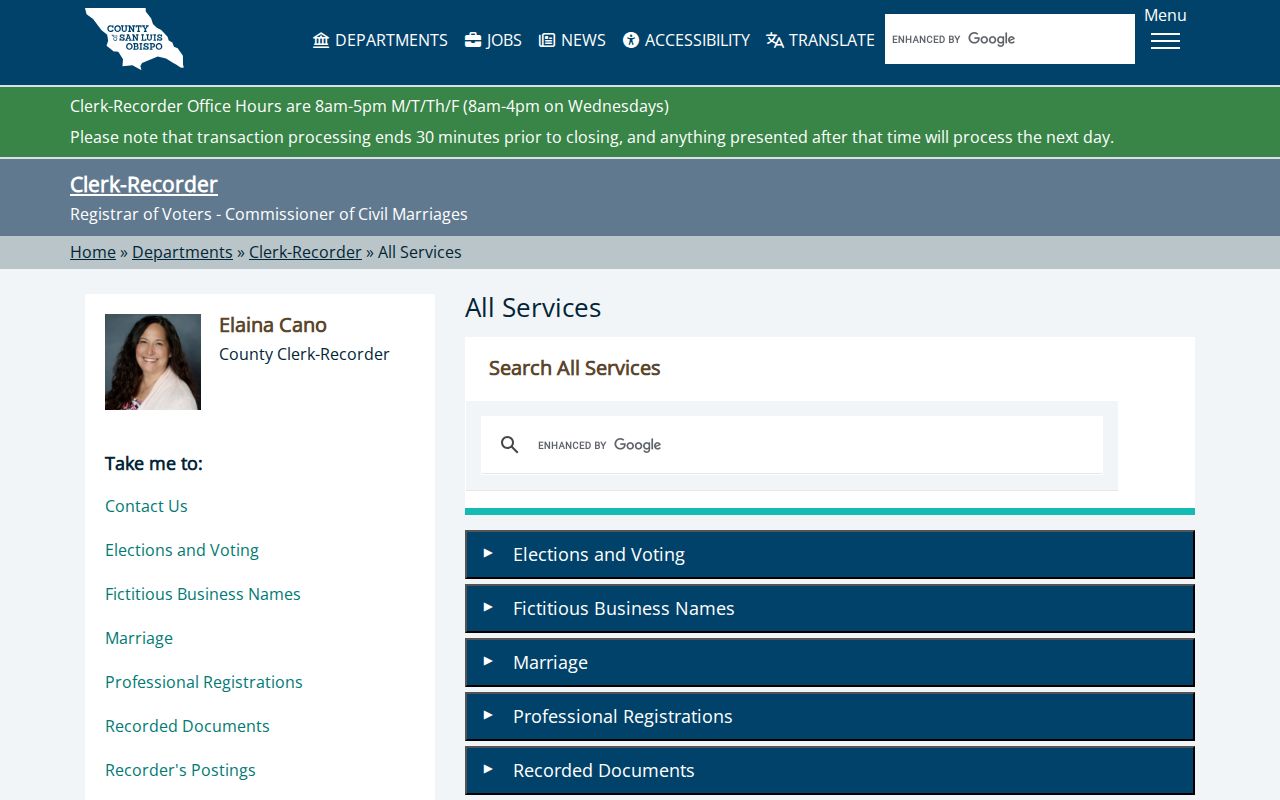
The Clerk-Recorder source belongs at the front of a previous residents search because it establishes which later household clues can be tied to a recorded parcel.
Atascadero Previous Residents: HON and DOC Tabs
The current address should first be translated into an APN through the SLO County Property Inquiry Portal. The portal publishes situs and mailing or owner addresses, land and improvement values, characteristics, parcel maps, ownership history, and document history. It is primarily an APN and situs route. Unrestricted owner-name web search is not offered, so the address or map is the reliable opening move.
After opening the parcel, read the HON tab for ownership history, grant dates, and recorder document numbers. Read DOC for document history. Capture the current owner, ownership share, APN, legal or subdivision reference, grant date, and document number before leaving the record. Keep the mailing address in a separate note. It can belong to a trust, business, manager, or an owner who lives elsewhere.
The Atascadero Assessor counter is at 6565 Capistrano Avenue, Monday through Friday from 8 to 4, (805) 461-6143. The main San Luis Obispo office is at 1055 Monterey Street, Suite D360, Monday through Friday from 8 to 5, (805) 781-5643. A counter visit is the fallback when a public web result does not expose the historical detail needed for previous residents.
Trace Atascadero Deeds Backward
A deed chain follows a recorded owner from the present toward earlier transfers. The recorder index is searched by parties and documents, not by a neat street timeline. Exact names matter. Use LAST FIRST without punctuation, then repeat with a wildcard or a spelling variant when the index allows it. The legal description and APN keep the chain attached to the same land as street wording shifts.
- Pull the current owner, APN, legal description, HON grant date, and DOC document number from the assessor record.
- Search the document number in the Official Records index, or search the current owner as a party within the relevant date range.
- Open or order the deed image when available, then extract the seller or grantor, buyer or grantee, legal description, and recording details.
- Search that seller as the earlier grantee. Repeat the handoff from grantee to grantor through the online index to its coverage limit.
- For earlier transfers, move to the Clerk-Recorder office indexes or deed books covering 1850 through 1922 and carry the APN, subdivision, and legal description with the request.
- Grantor and grantee
- The grantor transfers an interest. The grantee receives it. In a backward chain, today’s seller becomes the earlier grantee to find the prior deed.
- Chain of title
- The linked sequence of recorded transfers for one parcel or legal description.
- Legal description
- The lot, block, subdivision, or other land wording that identifies the property more durably than a changing street number.
- Criss-cross directory
- A reverse directory arranged around an address, street, or telephone entry rather than only an alphabetical surname list.
- Enumeration district
- A census area assigned to an enumerator. It lets a researcher browse page images by place when a name index misses a household.
- Index versus image
- The index is a finding aid. The deed image supplies the transfer language, signatures, notary block, and legal description.
A name match alone is not enough. Confirm the parcel description and recording date before assigning a seller to the same Atascadero address.
Atascadero Previous Residents and the 1923 Wall
Three dates organize a previous residents search in San Luis Obispo County. Recorded holdings reach 1850. The online names and documents index begins in 1923. Downloadable images begin August 8, 2001. The dates are not interchangeable. A 1923 search result is an index clue, while an older deed may exist in an office book even though it is not in the web search.
The online index is free to search and offers Name, Document Number, Document Type, Map Book/Page, Advanced, and recording-date fields. Eligible recent images can be placed in a cart after login. Older copies are ordered from the office. The Clerk-Recorder’s help number is (805) 781-5080. Provide a document number or book and page when possible, plus the associated name and map type for map requests.
The county Clerk-Recorder office page is the source for the custodian and its service channels.
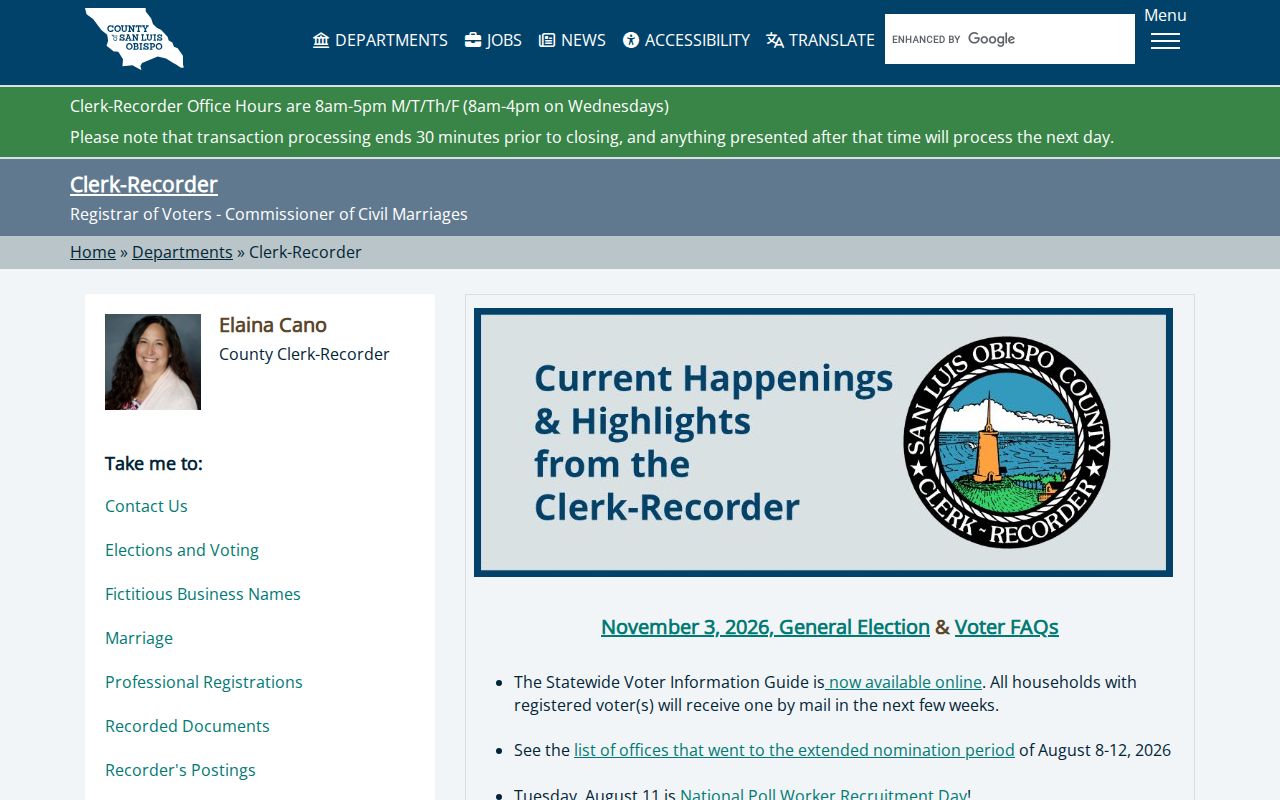
The county service view makes the fallback clear: when the online image cutoff blocks a house-history step, an office copy or older index request continues the trail.
Note: A no-result response at the 1923 web boundary does not mean the parcel had no earlier owner or recorded instrument.
Atascadero Address Names Do Not Stand Still
A local directory example shows why previous residents cannot be found by modern street text alone. In 1950, Polk evidence describes Richfield and Petersen service stations at South State Highway and The Mall. By 1954, Simpson’s Associated Service is listed at 6490 El Camino Real. A 1953 form uses “S state hway,” while other editions vary the proprietor’s name, nickname, occupation abbreviation, and trade name. The telephone evidence continues the thread in 1960.
No official citywide grid or renumbering year was located. Do not invent one. Preserve every old route description, intersection, business name, and number in the search notes. Then compare the APN, recorded legal description, parcel map, permit chronology, photographs, and any accessible fire-insurance map.
The 1913 Colony subdivision and its changing highway language make this bridge especially important in Atascadero. The parcel is the continuity anchor. Address wording is an index key that may need several forms.
Atascadero Households and Previous Residents
Previous residents are not limited to owners. A reverse directory can show a listed occupant or business at a selected address, and a census page can show a household on one enumeration date. Haines/Cole samples cover 1975, 1980, 1984, 1990, 1995, 1999, 2003, 2008, and 2013. Selected Polk editions cover 1946 through 1958, and Pacific Telephone supplies a 1960 check. These are valuable snapshots, not a continuous directory run.
The Atascadero Library at 6555 Capistrano Avenue, (805) 461-6161, holds a Local History Collection and high-school yearbooks. The San Luis Obispo Library at 995 Palm Street, (805) 781-5991, holds county-history books, documents, and newspapers on microfilm. Publisher runs and reading methods belong with the Atascadero city directory collections, while the address trail stays here.
The Atascadero Historical Society and Colony House Museum at 6600 Lewis Avenue, (805) 466-8341, is open Wednesday and Saturday from 1 to 4. Its PastPerfect link was unavailable during inspection, so a direct inquiry with a surname, business, address variant, and date range is the useful route.
The History Center of San Luis Obispo County keeps a research room in the Carnegie Library Building at 696 Monterey Street by special appointment. Its 2020 report estimated 112,350 items, while only 66,293 were then in PastPerfect. The appointment route can reach uncataloged family papers, government papers, ledgers, maps, scrapbooks, oral histories, newspapers, and photographs. Contact the research room at researchroom@historycenterslo.org or (805) 543-0638.
Use this household pairing sequence:
- Select a directory edition close to the question’s time and search both the alphabetical section and the classified or business section.
- Record the exact spelling, abbreviation, street wording, number, proprietor, and edition page. Preserve nicknames and initials rather than normalizing them away.
- Pair the address and name with the 1920, 1930, 1940, or 1950 census. If a name index fails, derive the enumeration district from the address or map and browse the page images.
- Use the APN, legal description, parcel map, and physical clues to bridge an address change between directory years.
- Test relationships with yearbooks, newspaper microfilm, obituaries, cemetery records, probate, and vital evidence, each with its own access rule.
The census is public through 1950 under the 72-year release rule. The 1960 census is not public until 2032. A directory entry and a census household are strongest when their date, address form, and independent relationship clues line up.
Atascadero Sanborn Maps and Permit Clues
The Library of Congress catalog identifies a February 1926 Atascadero Sanborn map with nine sheets and the secondary place label “Eaglet.” The catalog says the map is not available online. It can still guide a repository request or a physical research visit for footprint, use, and numbering context. A catalog entry is not a viewable image and should not be presented as one.
Atascadero eTRAKiT supplies current and recent permit, project, property, inspection, and business-license searches by site address. Results can include permit number, type, status, applicant, contractor or design professional, work description, fees, inspections, reviews, and chronology. The city warns that residential building records before the 1979 incorporation may instead be in County Clerk-Recorder holdings. That warning is a direct fallback rule for an older house history.
Use permits to date an addition, alteration, or project record. They can show who applied or worked on a file, but they do not prove who lived at the property. Planning documents can expose an exact project address when a permit search is incomplete.
The Atascadero Sanborn catalog record preserves the map’s nine-sheet and 1926 description.
Note: Physical-change evidence explains how an address developed; it does not replace a dated household source.
Close an Atascadero Previous Residents Trail
Once a name and address are anchored, court and family-history records can explain what happened after a household left. Obituaries and newspaper notices can supply relationships, but no authoritative exhaustive Atascadero obituary index was located. The Atascadero Cemetery District accepts public-record requests, yet no official online interment name index was found. Probate files and vital records can be endpoints, subject to eligibility, sealing, and redaction rules.
For a public legal-file question, the San Luis Obispo Superior Court offers civil copy instructions and post-2014 online case access through re:SearchCA. Federal cases for the county are in the Central District of California, with PACER as the federal search route. Court records can confirm a filing, party role, order, or probate matter. They do not by themselves prove that a party occupied the address.
The Central District of California court site identifies the federal court that includes San Luis Obispo County.
The federal court source is a route for a distinct legal record, not a substitute for the parcel and household evidence that establish an address history.
San Luis Obispo civil court file instructions explain how to seek copies of a court record.
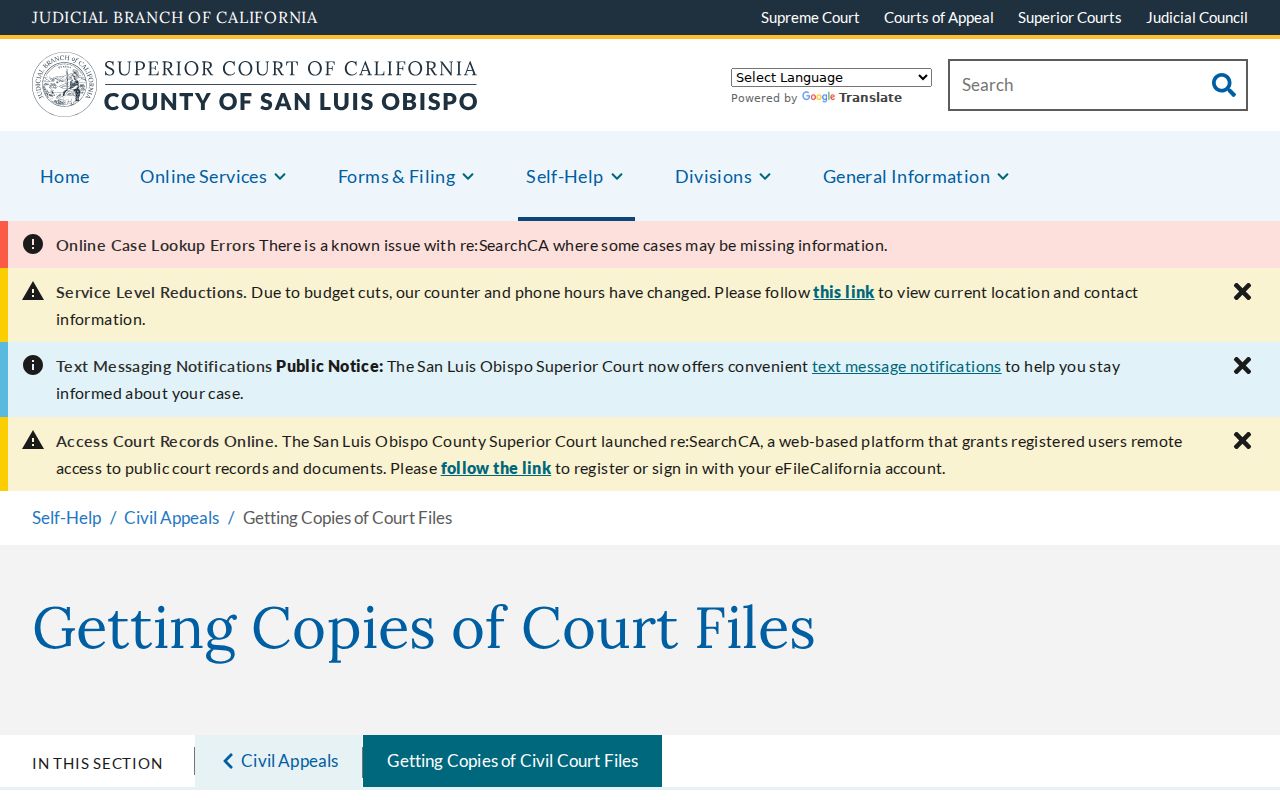
A civil file copy can close a legal-event question while leaving the occupancy question to directories, census pages, and other dated sources.
Lawful house history. Previous residents research in Atascadero is appropriate for family history, genealogy, and personal property history. Penal Code section 646.9 and Code of Civil Procedure section 527.6 prohibit stalking and civil harassment; a public record is not permission to track, threaten, repeatedly contact, or harm a living person.