
Atascadero City Directory Years on the Shelf
The verified Atascadero city directory record is a set of useful waypoints rather than a continuous annual series. R. L. Polk evidence names San Luis Obispo County or city editions for 1946-47, 1948, 1950, 1953, 1954, 1955, 1957, and 1958. A 1961 bibliography specifically says Atascadero was included. That statement supports the town's presence in the larger publication, but it does not prove that every intervening volume survives locally. Later Haines and Cole criss-cross samples are confirmed for 1975, 1980, 1984, 1990, 1995, 1999, 2003, 2008, and 2013.
| Collection | Years | Where Held | Access |
|---|---|---|---|
| R. L. Polk San Luis Obispo County/city directories | 1946-47, 1948, 1950, 1953-55, 1957-58; Atascadero included in 1961 bibliography | Local cultural-resource reports and library or archive inquiries | Verified editions, shelf run unconfirmed |
| Haines and Cole criss-cross directories | 1975, 1980, 1984, 1990, 1995, 1999, 2003, 2008, 2013 | San Luis Obispo County Public Works environmental directory evidence | Sampled years, not a continuous run |
| Pacific Telephone directory | 1960 | City cultural-resource report and local research leads | One verified volume |
| Atascadero High yearbooks | 1953 specifically cited; other branch years unspecified | Atascadero Library Local History Collection and related repositories | In-person reference inquiry |
| Federal census schedules | Through 1950 public | National Archives and library genealogy access | Free images and index, census companion |
The gaps matter. No exhaustive local city-directory shelf run, obituary index, or HeritageQuest entitlement was confirmed. A catalog or report can identify a title without showing where every surviving copy rests. Treat the years above as search targets, ask a librarian or archivist about uncataloged material, and record the edition and page when a name appears. The older Polk listings are especially useful for proprietor names, trade names, occupations, street wording, and intersections. The reverse volumes answer a different question by turning an address into a listed occupant or business. A city directory search is strongest when it states which edition was checked and what the volume actually covers.
Atascadero Directory Research at Local Repositories
Atascadero Library, 6555 Capistrano Avenue, is the first local stop for North County context. The branch lists a Local History Collection with regional books and high-school yearbooks. Posted hours are Tuesday and Wednesday 10 to 6, Thursday 9 to 5, Friday 1 to 5, and Saturday 9 to 5; it is closed Sunday and Monday. Call (805) 461-6161 before a trip, because a city directory or yearbook may be reference-only or held in a nearby collection. The county library branch information is useful for confirming location details, while the California State Library genealogy resources point toward broader catalog and genealogy routes.
The San Luis Obispo Library at 995 Palm Street, (805) 781-5991, adds county books, yearbooks, documents, and newspaper microfilm. The Atascadero Historical Society and Colony House Museum, 6600 Lewis Avenue, is open Wednesday and Saturday from 1 to 4 and can be reached at (805) 466-8341 or atascaderocolonymuseum@gmail.com. Its online PastPerfect link was unavailable during research, so a direct inquiry with a surname, address, business name, and date range is the sounder route. The History Center of San Luis Obispo County, in the Carnegie Library at 696 Monterey Street, has a museum open Thursday through Monday from 11 to 5 and a Research Room by appointment at researchroom@historycenterslo.org or (805) 543-0638. Cal Poly Special Collections adds regional photographs from 1850-1980, the Louis Family Papers from 1879-2009, and a Central Coast farm labor collection from about 1960-2003.
The California State Library genealogy page gives a useful reference starting point for an Atascadero city directory search when a local shelf is incomplete.
That statewide path helps place a local name in census, newspaper, map, and catalog work without treating a single directory year as a full resident list.
The Atascadero Historical Society history page supplies the local Colony and incorporation context behind the city directory trail.
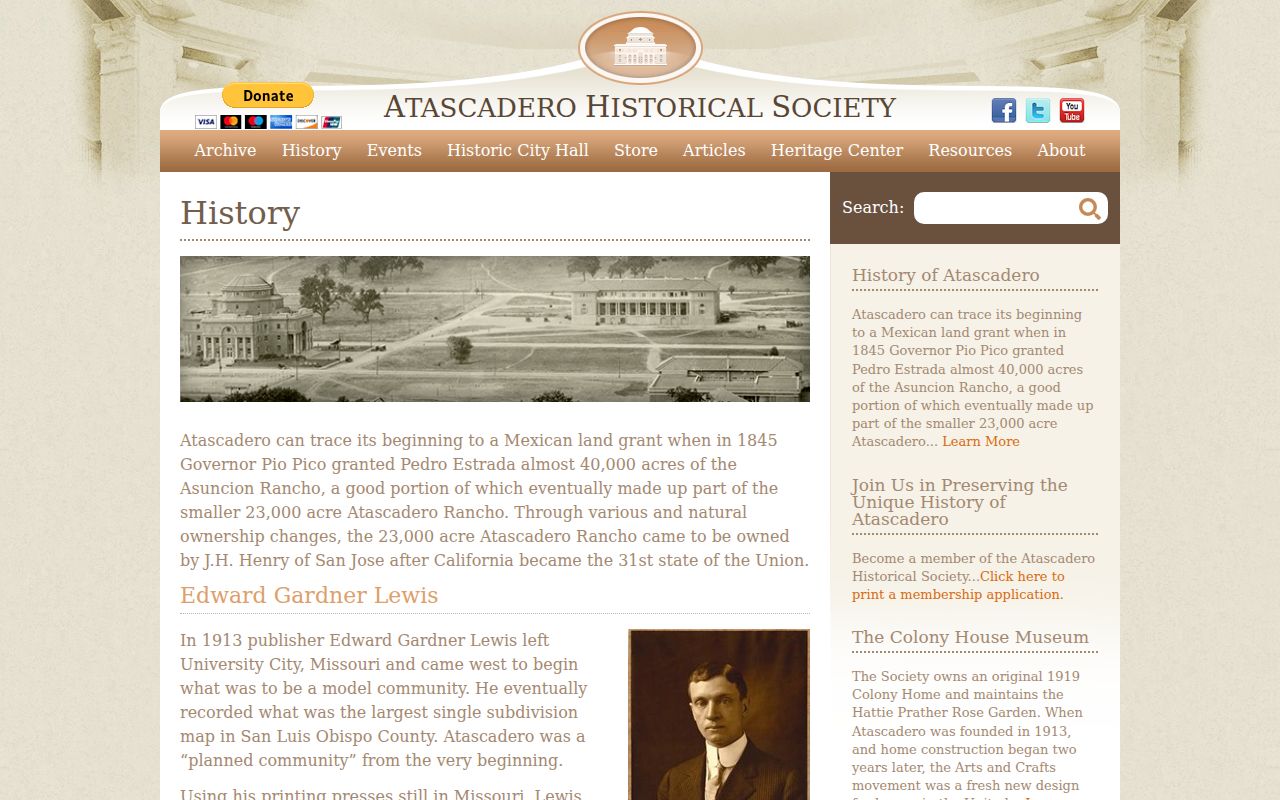
The Society's history helps explain why a printed entry can sit inside a much larger story about E. G. Lewis's planned Colony, changing roads, and Atascadero's 1979 incorporation.
Insider tip. A 2020 History Center report estimated 112,350 items, including 24,714 archival items, 22,604 library items, and 51,970 photographs, while only 66,293 items were then in PastPerfect. An appointment may therefore reach family papers, government papers, ledgers, maps, scrapbooks, oral histories, newspapers, or periodicals that a simple online catalog search misses.
Reading a 1954 Atascadero City Directory Entry
A 1954 Polk entry shows why an Atascadero city directory must be read as an index with local clues. One listing names “Simpson's Associated Service, 6490 El Camino Real, Atascadero.” A related personal and classified form gives “Simpson's Associated Service (Lorenzo P. Simpson), gas sta, 6490 El Camino Real.” The entry joins a trade name, proprietor, abbreviated activity, street number, and town. A 1953 form instead says “Lorrie P Simpson, serv sta S state hway,” while 1946-47 uses “coin opr” and the 1957 evidence calls the station “Flying A.” These are not interchangeable spellings. They are search keys.
| Name | Person, family, or trade name; a proprietor may appear in parentheses after a business name. |
|---|---|
| Occupation or trade | A brief activity label such as service station or coin operator, often abbreviated by the publisher. |
| Address | A numbered street, route description, or intersection. Old road wording may not match today's address. |
| Owner or renter mark | A symbol or letter used by a particular volume, when present. It is a historical notation, not proof of present status. |
| Spouse or note | Parentheses, widow notation, or a related line can supply a family clue, but it must be checked against another record. |
- Criss-cross directory
- A street-order section that starts with an address and names the listed occupant or business.
- Householder index
- An alphabetical name section that points to the household or address entry for a person.
- Abbreviation key
- The publisher's guide to short trade, relationship, and address terms. Photograph or transcribe it before reading pages.
Start with the page's abbreviation key, then copy the entry exactly before expanding a term. “S state hway” may be a better search phrase than a modern road name. A name in the alphabetical section can be paired with the classified section, and a business in the classified section can be paired with the reverse address section. That three-part check is often more reliable than a single spelling.
Atascadero Reverse Directories and Telephone Clues
Later Haines and Cole volumes are the reverse side of the Atascadero city directory story. The verified samples from 1975, 1980, 1984, 1990, 1995, 1999, 2003, 2008, and 2013 can turn a street number into a listed occupant or business. They are useful checkpoints, not proof of an annual run. The 1960 Pacific Telephone volume supplies a separate phone and business clue. Compare its name, number, and address with the Polk evidence rather than merging all appearances into one uninterrupted record.
The local record history also explains why road language changes. Atascadero began as E. G. Lewis's planned Colony in 1913, and the city's incorporation in 1979 shifted some building-record questions toward the city while older residential files may be in county Clerk-Recorder holdings. A street-order search therefore needs both the printed address and the parcel or legal description when the road name has changed.
A compact timeline keeps the collections in order:
- 1913: The planned Atascadero Colony establishes the land and road context behind later address records.
- 1946-1958: Verified Polk editions provide selected names, businesses, occupations, and address clues.
- 1960: Pacific Telephone adds a verified phone-book checkpoint.
- 1975-2013: Haines and Cole samples provide later reverse-directory checkpoints.
- 1979: Incorporation creates a practical city-versus-county split for older building records.
Trace a Household Through Atascadero City Directories
Family history work benefits from a fixed sequence. A city directory can show a person between census years, but the entry is a clue about a listed address or trade. It does not establish title, a complete household, or a current connection. Preserve the edition, page, exact wording, and any alternate name before moving to the next source.
- Find the first likely appearance by surname and given name. Record initials, nicknames, married names, and the page number.
- Search the alphabetical, classified, and business sections. The Simpson evidence shows why a proprietor, nickname, and trade name may all matter.
- Turn to the criss-cross section for the street or number. Note nearby entries, but do not treat neighboring listings as proof of family ties.
- Pair the directory point with the 1940 or 1950 census. If a name search fails, use the address and enumeration-district maps to browse images.
- Close a move or death question with a deed, permit chronology, newspaper notice, cemetery record, probate file, or vital-record index.
A disappearance has several explanations: the person moved, the publisher skipped an entry, the name was printed under a spouse or nickname, or the household was no longer listed. The public 1950 census is the latest released schedule as of 2026; the 1960 census remains closed until 2032. A name-only city directory search cannot choose among those explanations by itself.
When a historical entry needs a modern identity check, the Atascadero resident lookup process can pair an independent address, case, event, license, or parcel anchor with the directory clue.
Atascadero Yearbooks Beside the City Directory
The 1953 Atascadero High yearbook is specifically cited in the local research, while other yearbook years at the branch are not specified. Yearbooks can add student names, clubs, advertisements, and local business context that a city directory omits. The San Luis Obispo Library's county books, yearbooks, documents, and newspaper microfilm can fill a date gap. A yearbook appearance is a school-year clue, not a complete residence record, so compare its name and address references with a directory, census, or family paper.
Cal Poly Special Collections can widen the search when the question is about a family, neighborhood, or local institution. Its finding aids include regional photographs from 1850-1980, the Louis Family Papers from 1879-2009, and a Central Coast Farm Labor Organizing Collection from about 1960-2003. Those materials may provide images, correspondence, or organizational context even when no searchable city directory entry survives. The History Center's appointment-based Research Room is another path for uncataloged local evidence.
Note: A yearbook or newspaper mention can place a person in Atascadero without proving that the listed address was the person's full-time home.
Eaglet in an Atascadero Directory Search
A directory search can fail because a researcher searches only the present city name. The Library of Congress catalog record for the February 1926 Atascadero Sanborn map identifies nine sheets and includes “Eaglet” as another place label. The catalog is valuable for discovering the map, but it states that the images are not available online. The broader Sanborn Maps collection explains the map series; the Atascadero catalog record is the local citation.
This is context for a city directory, not a resident index. A map can help compare a footprint, business use, route name, or old number with a directory entry. The Simpson trail makes the same point in a different way: “South State Highway” near The Mall later appears as 6490 El Camino Real. Search both descriptions, then use a parcel map or legal description before deciding that two entries refer to different places.
Quirk: When the name search feels empty, try the alternate place label, the business category, the proprietor's nickname, and the old road wording before abandoning the year.
Atascadero City Directory Limits and Next Steps
An Atascadero city directory is a historical finding aid. It may omit children, visitors, unlisted households, people who moved between editions, and anyone outside the publisher's coverage area. A reverse listing can place a name at a number for one edition, while a deed identifies a legal interest and a census captures a household at one enumeration date. Those sources answer different questions. A missing name is therefore not a negative finding.
For a focused inquiry, give the Atascadero Library or Historical Society a surname, given-name variants, business or school connection, address forms, and an approximate year range. Ask whether the relevant volume is on the shelf, in a local report, or available through an appointment collection. If the question reaches before incorporation, ask the county Clerk-Recorder about the older record route. Keep a source log with the exact title, edition, page, repository, and result.
Research boundary. No verified source supports an exhaustive Atascadero obituary index or a continuous city directory run. Use the confirmed years as waypoints and state the gap when reporting a result.