
Starting an Atascadero Residents Directory Search
Start with the strongest anchor, not the broadest search box. An address converts to a parcel number. That parcel opens the assessor record, the map, ownership history, and recorder documents. A name works differently. It can surface a court party, a license record, or an old directory entry. But a common name needs a second fact before it belongs to one person. Early Atascadero records rarely use modern street numbers. So an old address may call for a street description, a trade name, or a nickname.
Each record answers its own question. The assessor speaks to ownership and the tax mailing address. A deed names the parties to a recorded instrument. A directory shows a listed occupant or business. A voter tool checks your own registration, not a public household list. Treat each custodian's terms, dates, and limits as part of the result itself.
- Write down the name, address, date range, and any middle initial or relative already known.
- Use the San Luis Obispo County parcel and map tools when an address is the best starting clue.
- Move from the APN or legal description to the County Clerk-Recorder index when ownership history matters.
- Use the court, vital, license, or unclaimed-property source that matches the question instead of treating one index as complete.
- For older households, pair a directory or yearbook entry with a census, obituary, cemetery, or local-history source.
Atascadero Records Offices in Practice
Atascadero is not the county seat. That split shapes every search. City hall holds municipal files, permits, planning material, elections records, and police reports, while the county keeps the official record index, assessor data, vital certificates, and court files. One county counter sits at 6565 Capistrano Avenue. Principal clerk-recorder and Superior Court work still routes through San Luis Obispo.
San Luis Obispo County Clerk-Recorder
Official records, vital records, marriages, FBN filings, and elections
(805) 781-5080
San Luis Obispo County Assessor
North County counter, 6565 Capistrano Avenue
(805) 461-6143
Atascadero City Clerk and Elections
City files, council records, elections, and CPRA routing
(805) 470-3400
The Atascadero City Clerk keeps council proceedings and ordinances. Resolutions, contracts, claims, FPPC filings, and related correspondence are there too. For property ownership, the county assessor counter is the local fallback. The public web portal does not offer an owner-name search. Each office can confirm only what it holds.
Atascadero Address-to-APN Records
Begin with the place itself when a name is shaky. The San Luis Obispo County Property Inquiry Portal is built around the assessor parcel number, or APN. Its public view returns situs and mailing addresses, land and improvement values, property characteristics, and parcel-map PDFs. The situs is the physical parcel. The mailing address is where tax bills travel. The two can match, but a match does not prove occupancy.
The county's Interactive Data Viewer adds a map route. Zoom to an Atascadero address, select the parcel, save the APN, and study adjacent shapes or land-use layers. Address chains continue in the Atascadero street directory. GIS owner-mailing and planning-property fields serve different purposes. A map display helps locate a parcel, but it is no legal survey and no substitute for the recorded instrument.
| Search field | Type | Required | Notes |
|---|---|---|---|
| APN | Parcel identifier | No, when starting from an address | Primary key for the public Property Inquiry Portal. |
| Situs address | Address or map clue | Starting clue | Locates the physical parcel before the APN is captured. |
| Mailing address | Displayed result field | No | Tax correspondence address, which may differ from the site. |
| Characteristics and values | Displayed result fields | No | Land, improvements, structures, exemptions, and assessment details. |
| Parcel map PDF | Linked map result | No | Map reference arranged through the assessor's parcel-map system. |
An address-first chain is the soundest link between an Atascadero place and a named record. It keeps ownership facts apart from household guesses. Start at the county Property Inquiry source.
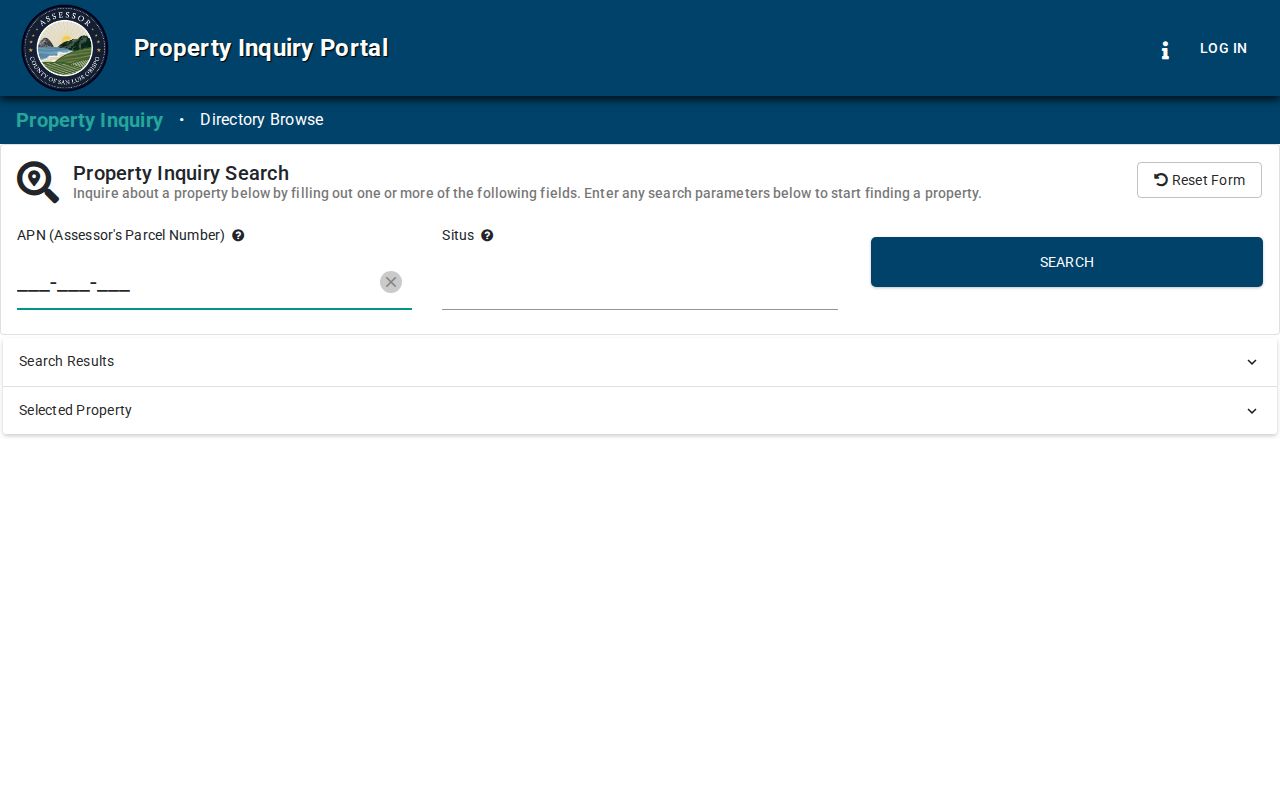
The portal view separates address, parcel, and ownership upfront.
Three Dates in Atascadero Recorder Records
Three time markers govern the San Luis Obispo County Clerk-Recorder's holdings. Recorded documents reach back to 1850. The online Official Records index starts in 1923. Downloadable or purchasable images begin on August 8, 2001. These cutoffs explain one common quirk. A search returns a party name yet stops short of an image. Older requests need an office or book search.
The Official Records Search offers Name, Document Number, Document Type, Map Book/Page, and Advanced modes, plus recording-date start and end fields. A grantor or grantee name is the main route for a deed trail, and the index shows party role, document type, recording date, document number, and book/page. For vesting language, legal description, consideration clues, signatures, and notary details, you need the deed image itself.
- 1850: County recorded holdings reach this early period. Ask the office about earlier indexes or books.
- 1923: The online name and document index begins. Search name variants and date windows online.
- August 8, 2001: Eligible document images can be purchased or downloaded online. Use the cart or order an older copy.
County instructions list a copy charge of $7 for the first page, $1 for each additional page, and $1 for certification. The checkout page controls the final amount. Older copies can be requested from the office. The free index is only a lead. Check the Official Records source before moving from a name hit to a purchased image.
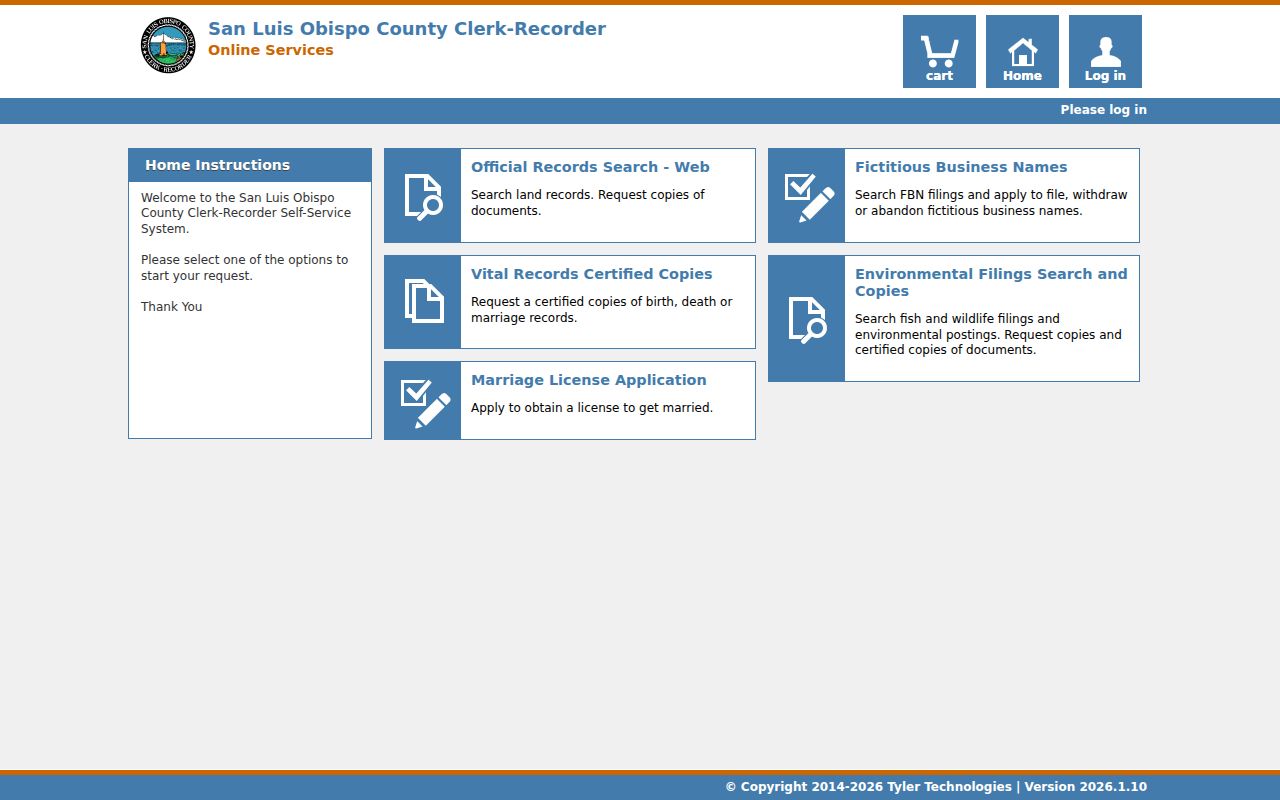
The index landing view sets the coverage boundary first. No searcher should assume every old Atascadero deed is online.
Atascadero Resident Records by Site
City files open another door for Atascadero address research. The eTRAKiT portal gives the public search tiles. They cover permits, projects, properties, registered professionals, and business licenses. Permits are searchable by site address. A single result can name an applicant, contractor, or design professional. It can also add the permit type, status, date, valuation, work description, review, fee, or inspection. Availability differs from record to record. A named file may not be in the portal. The city's public-record request form is the fallback then. It asks for a description by type, date, subject, and title. Categories span building, business-license, planning, police, fire, and other records. The city allows ten days for a determination. Unusual circumstances can bring a written extension of up to fourteen more days. Copies cost $0.50 for the first page and $0.10 for each additional page.
- Site Address
- Address route for current and recent permit activity.
- Street Number and Street Name
- Split address fields when the portal presents them.
- Permit Number
- Exact-key search when a city identifier is known.
- Permit Type and Status
- Portal-dependent filters that narrow the record set.
- Date range
- Optional way to narrow activity where the live portal offers it.
A permit can date a change to an Atascadero property, but it cannot prove everyone who lived there. Applicant, owner, professional, and occupant are different labels, so keep them distinct.
Atascadero Court Records and Name Variants
San Luis Obispo Superior Court handles Atascadero court matters. Cases filed after 2014 go through re:SearchCA, a participating-court platform rather than a complete statewide docket. Its Party Name mode takes first, middle, and last names. Case Number is a separate route. Filters for court or location and for category or date may also appear. Remote documents depend on the case and access rules. A visible case result can include the case number, title, party roles, case type, filing date, and court location. Register-of-actions events, hearings, and a disposition or status may show up too. Sealed, juvenile, adoption, and confidential family records stay hidden. For older criminal name research, the clerk applies exact-name rules and skips date of birth for third-party searches. File each spelling and middle-name variation separately.
- Case Number
- Exact case route, best when an identifier is already known.
- Party Name
- First, middle, and last name route; run variants separately and compare party role.
- Location or Court
- Participating-court selection that keeps San Luis Obispo County in scope.
- Category or date
- Optional narrowing whose availability depends on the court configuration.
The kiosk at the courthouse shows permitted criminal documents. Older requests travel by mail, email, or in person. Mail goes to 1050 Monterey Street, Room 220, San Luis Obispo. Email goes to SLOCRIM@SLO.COURTS.CA.GOV. The court charges $0.50 per page. It also charges $15 for research over ten minutes, and $40 per certified document or case summary. The SLO court search source offers the post-2014 entry point.
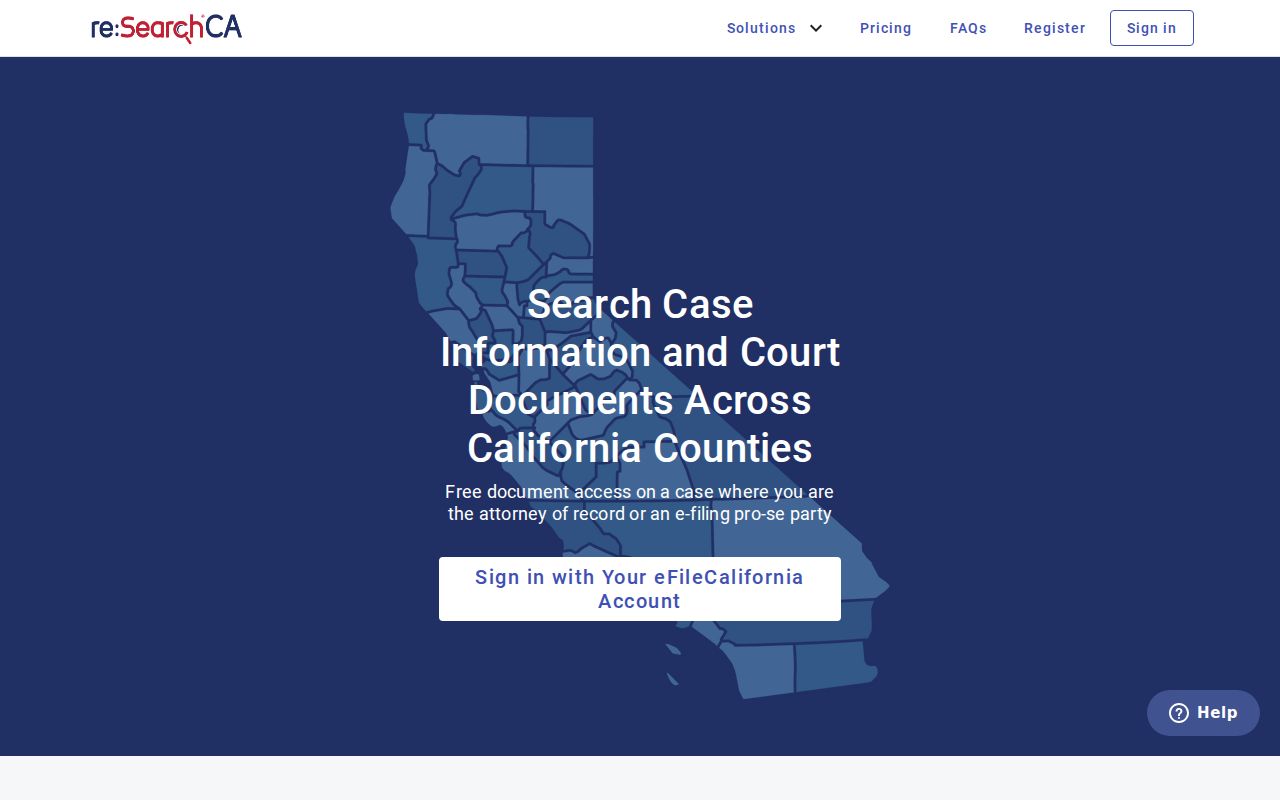
A court name hit is only a lead. Tie it to one Atascadero resident with a second anchor, such as a case number, date, relative, or address clue.
Atascadero Voter Records Have a Narrow Use
California's My Voter Status tool verifies one person's own registration. It asks for a first name, last name, and date of birth. The last four digits of a driver's license or California identification card are also required. It is not a public by-name Atascadero residents directory. The public voter file sits under Elections Code sections 2180 through 2194. Candidates, committees, and people working for election, political, scholarly, journalistic, or approved governmental purposes may apply. Fields can include a name, date of birth, registration date, residence or mailing address, precinct, contact information, party preference, and permitted history. Driver numbers, ID numbers, and signatures are excluded. Personal, private, commercial, marketing, and Internet-republication uses are restricted. Section 18109 makes unauthorized use a misdemeanor. The California voter-status source holds the personal verification form.
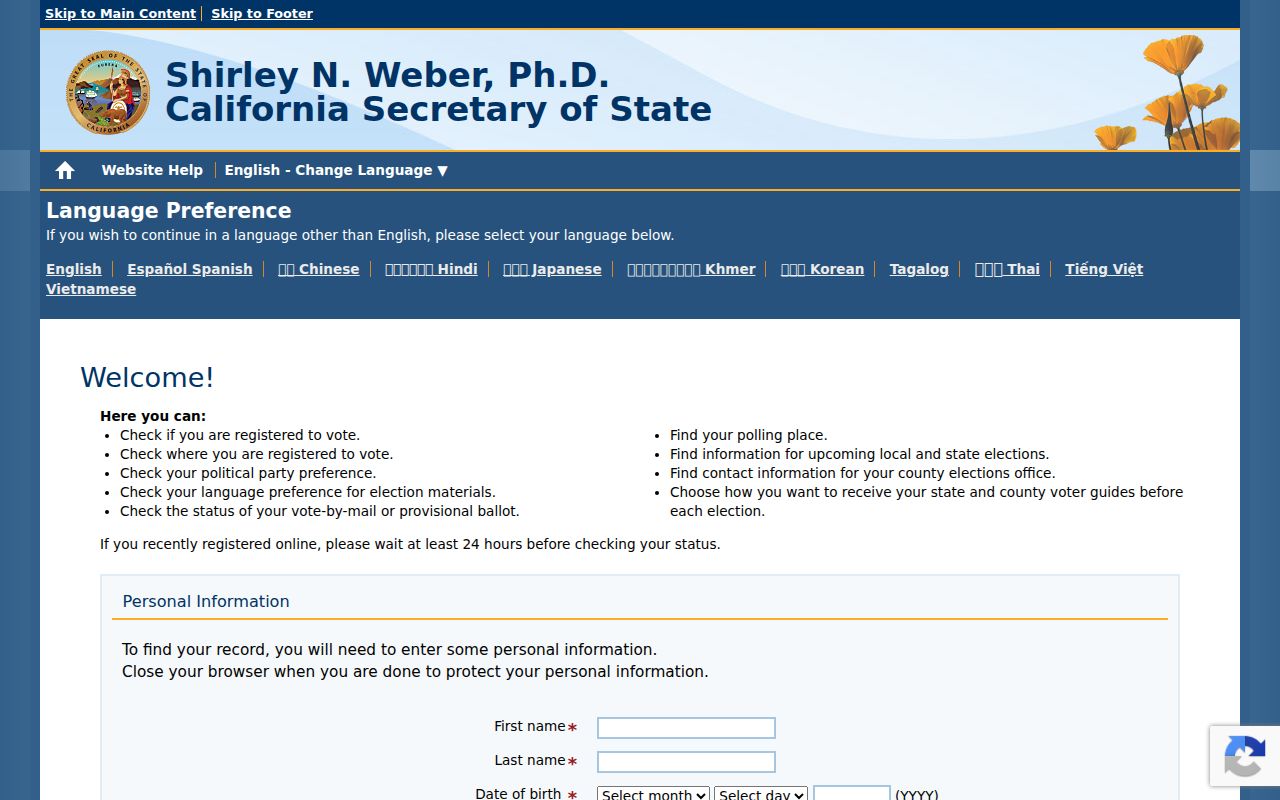
A voter-status result speaks only for the person matched. It confirms that person's registration information, not every resident at an address.
Current Atascadero Resident Directory Sources
No single current roll lists everyone in Atascadero. The useful sources overlap, yet each one keeps different records under different access rules. The table separates those keeper roles.
| Source | Who or what it can identify | Keeper | Access |
|---|---|---|---|
| Property Inquiry Portal | Parcel, owner or share where shown, situs, mailing, values | County Assessor | APN and address route |
| Official Records index | Parties to deeds, liens, releases, maps, and notices | County Clerk-Recorder | Free index, paid or ordered copies |
| eTRAKiT | Permit, project, property, professional, and business-license contacts | City of Atascadero | Public search; features vary |
| My Voter Status | One person's registration status | California Secretary of State | Personal identifying data required |
| Library and archive collections | Historic occupants, students, businesses, and family context | Libraries and repositories | Shelf, appointment, or collection rules |
Official sources make the best first check. Their fields and limits sit in plain view. A paid compilation can gather many data types, but its result still needs confirmation from the custodian behind the underlying record.
| Route | Useful strength | Limit to keep in mind |
|---|---|---|
| Official county, city, court, or state record | Named keeper, stated fields, and a way to request correction or a certified copy | Coverage, eligibility, and privacy rules differ by record type |
| Library, archive, or historical collection | Older names, households, businesses, photographs, and local context | Years may be sampled, onsite, incomplete, or not fully cataloged |
| Paid people-finding compilation | Convenient aggregation of public and licensed data | May be stale or misattributed and is not official proof of identity or residence |
For one living person, use two independent sources. Note what each source actually proves. A title party, permit applicant, business agent, and household member are not interchangeable labels.
Atascadero Vital Records and Copy Types
Birth, death, and marriage records are event clues. San Luis Obispo County Clerk-Recorder handles county events. Statewide applications run through California Department of Public Health Vital Records. California splits certified copies into authorized and informational versions. An informational copy can support research, but it carries a notice that it is not valid to establish identity.
- Birth and death
- County Clerk-Recorder or CDPH. Authorized categories and informational copies differ, and sensitive data remains protected.
- Public marriage
- County license office or CDPH. Authorized and informational copy rules apply.
- Confidential marriage
- The county that issued the license holds the record. Access is generally limited to spouses or court order under Family Code sections 509-511.
- Adoption and original birth records
- CDSS, court, or holding agency. These records are generally sealed under Health and Safety Code section 102705 and Family Code section 9200 et seq.
The 2026 CDPH schedule lists $31 for birth, $26 for death, and $19 for marriage. A divorce certificate of record costs $18. The county schedule effective July 1, 2026 charges $34 for birth and $26 for death. A fetal death copy is $23, and marriage is $19. A certificate fee covers search and processing. A no-record response does not prove an event never occurred. The practical comparison stays simple. An index hit supplies a lead. An informational copy supplies event information with a restriction. An authorized certified copy is the identity-grade document for an eligible requester. A divorce certificate of record is not the full decree or court file.
Historical Atascadero Resident Directories
Old-fashioned directory research for Atascadero lives in libraries and archives. Selected Polk editions survive for 1946-47, 1948, 1950, 1953, 1954, 1955, 1957, and 1958. A 1961 bibliography notes Atascadero's inclusion. Pacific Telephone gives a 1960 checkpoint. Haines and Cole criss-cross volumes sample 1975, 1980, 1984, 1990, 1995, 1999, 2003, 2008, and 2013. Treat these as scattered years rather than a continuous run of the Atascadero residents directory.
The Atascadero city directory collections page covers that historical shelf in depth. Atascadero Library holds North County books plus high-school yearbooks. The Historical Society and History Center add family papers, ledgers, photographs, newspapers, oral histories, and government records. These can name people no modern web index reaches.
Atascadero Yearbooks and Local Collections
Atascadero Library sits at 6555 Capistrano Avenue. It maintains a Local History Collection of North County history books and high-school yearbooks. A 1953 Atascadero High yearbook is cited among its holdings. The catalog also points to works on the Colony, the historic business district, E. G. Lewis, and local church and school history. A resident lookup sometimes needs a date or a relationship. These volumes supply class, club, business, and family context.
Deeper digging takes several routes. The History Center of San Luis Obispo County opens its Research Room by special appointment. Its 2020 report estimated 112,350 items across archives, library material, and photographs. Only 66,293 items were then in PastPerfect. That gap matters. An uncataloged item is not a missing item. Atascadero Historical Society materials, Cal Poly Special Collections, newspapers on microfilm, and city council records round out the options.
- Roll
- A record set maintained for a defined purpose, such as assessment or registration.
- Index
- A finding aid with names or document references, not always the full record image.
- Criss-cross directory
- A reverse directory arranged by address or street so an occupant or business can be found from a place.
- Parcel
- A defined piece of land identified by an APN and related legal description.
Atascadero House History Before 1923
Atascadero's Colony-era past makes address language tricky. E. G. Lewis founded the planned Colony in 1913 on a large rancho. Earlier records often identify a place by road, intersection, or business. Some use a route description instead of a modern street number. The 1926 Sanborn catalog record shows the problem. It holds nine sheets and names Eaglet in its title. The Library of Congress images are unavailable online.
Past the 1923 index wall, ask the Clerk-Recorder about older books or office-held copies. Pair the deed trail with Polk, telephone, census, cemetery, probate, newspaper, and History Center material. An address is one clue. APN, subdivision, legal description, proprietor, business name, and old road wording can close the gap.
- Proprietor name
- Links a classified or business entry to a person, such as Lorenzo or Lorrie Simpson.
- Trade name
- Finds the same place after a business label changes, such as Associated and Flying A.
- Old route wording
- Connects South State Highway and The Mall to the later numbered address at 6490 El Camino Real.
- Legal description
- Identifies land when street text shifts through a subdivision, lot, map, or deed description.
Atascadero Privacy and Protected Addresses
Public records stop at certain lines. The assessor roll does not name every occupant. A deed does not prove who sleeps at a property. The federal Driver's Privacy Protection Act restricts DMV address information. Voter identifiers and signatures stay withheld, and voter-file use is limited. Police reports, juvenile material, and sealed cases each follow their own rules. Adoption records, confidential marriages, and protected addresses follow their own rules too.
California's Safe at Home program lets qualifying survivors use a substitute address. Certain public workers qualify as well. Enrollment runs through a designated agency, not an open online application. Even so, property bought in a participant's own name can still reveal a legal description. Voluntarily giving an actual address to an agency can weaken protection for that record. A missing name never proves a person is absent.
Lawful use. Atascadero records are for personal, lawful research, family history, civic understanding, and safety planning. Do not use a name or address to stalk, harass, intimidate, threaten, or harm another person.
Atascadero Business and Property Clues
A name search often sharpens in a different way. It gains traction once a person connects to a registered business or professional role. The California Secretary of State's bizfile Online search takes a name or file number. Advanced filters cover entity type, status, initial date, and begins-with matching. Results can show formation, status, jurisdiction, addresses, agent, statement due date, and filing PDFs. Read the agent address carefully. It serves legal process and is not automatically a residence. The Secretary of State collects no beneficial ownership, phone, email, or subsidiary data.
The State Controller's unclaimed-property search is free. It can surface a reported owner name and locality. That match points to reported property, not a current home. The Department of Consumer Affairs license search adds board, license type or number, business, first name, last name, and registry fields for covered boards. Treat each hit as a narrow affiliation clue rather than proof of a household.
Start with the California business-search source for the entity lookup entry point.
Entity data can strengthen a name match in an Atascadero lookup. It is never a household roster or proof of residence.
Atascadero Records Access Changed in 2026
San Luis Obispo Superior Court moved its public access route on July 1, 2026. Most post-2014 case records now run through re:SearchCA. However, copy requests and courthouse kiosks still work. The county's July 1, 2026 fee schedule lists updated charges. These cover official copies and vital records. California's DROP platform also started broker deletion processing on August 1, 2026. That opened a new privacy route for covered data-broker records.
City records stay available through the Atascadero public-record request form. It asks for the record category and a focused description. The form notes that residential building records predating the city's 1979 incorporation may sit with the County Clerk-Recorder instead. That note is a local records fact. It is also a useful next step for a resident lookup that stalls at the city level. For anyone tracing past residents of Atascadero through deeds or property rolls, the recorder path matters as much as the city form.
The Atascadero public-record request source remains the city's official request route.
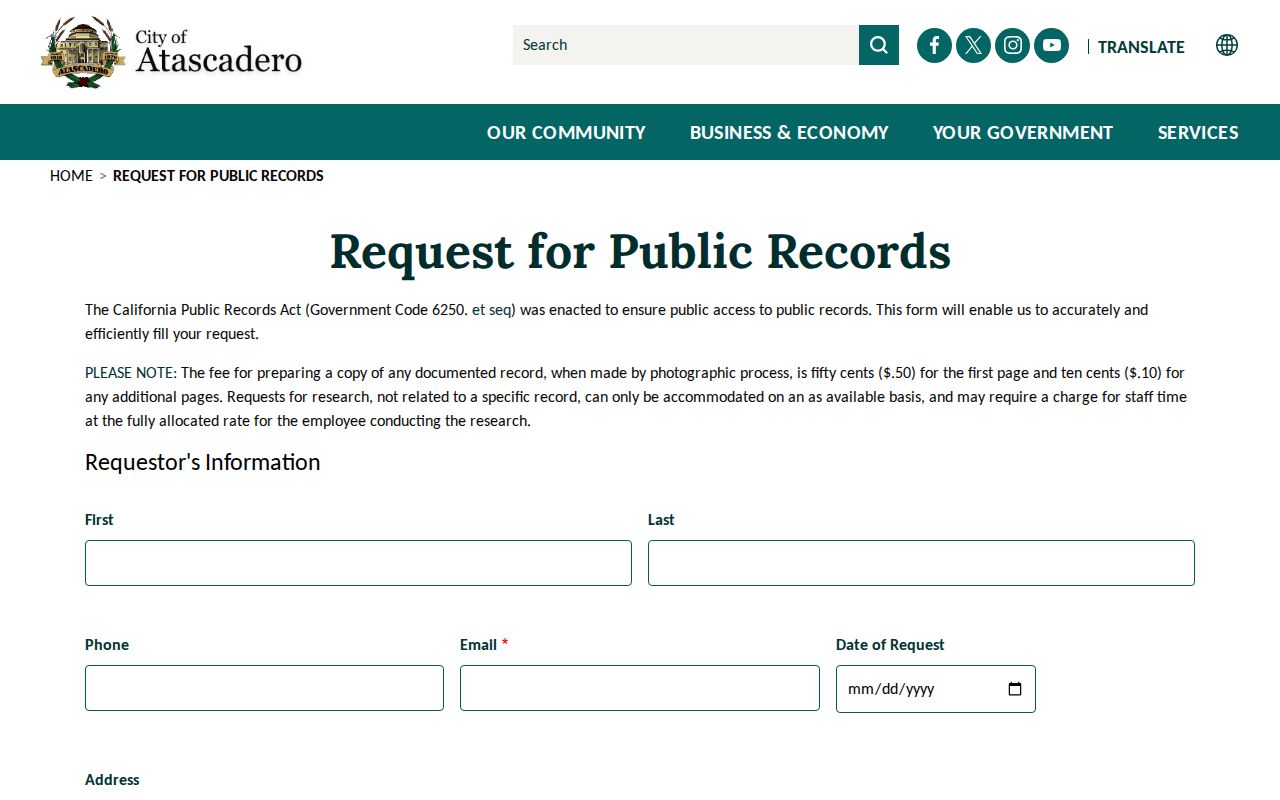
A focused request works best. Name the record you want, the date range, the subject, or the title, so staff can pull it straight away.
The Atascadero records office does not assemble new answers from scattered files. Its job is to provide records that already exist.